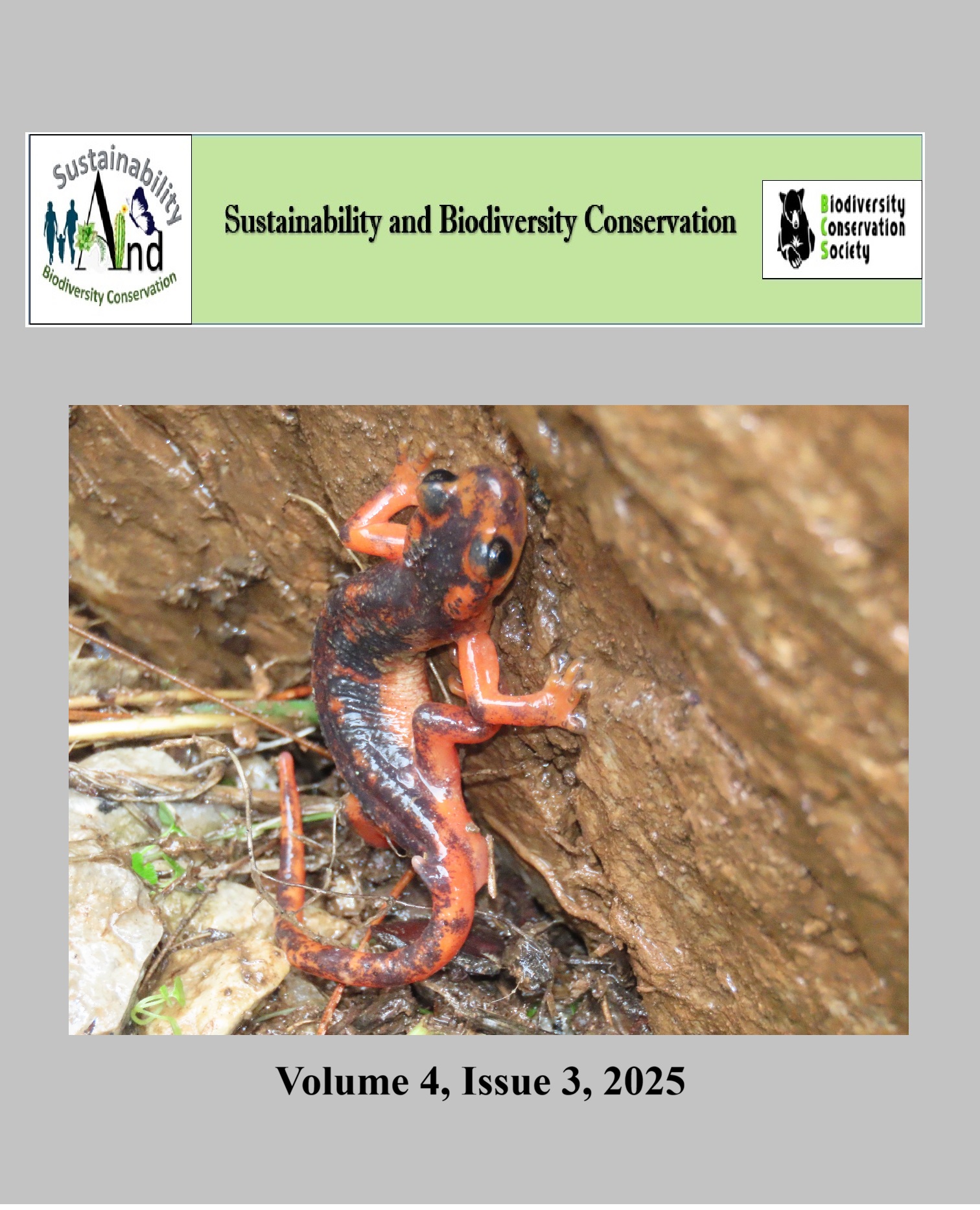
Ecosystem services, biodiversity, and resilience against global climate change
DOI:
https://doi.org/10.5281/zenodo.18008319Keywords:
ecosystem services, biodiversity, resilience, climate change, adaptation, ecosystem-based solutions, sustainable developmentAbstract
The accelerating impacts of global climate change are clearly observable in many parts of the world. In much of the Middle East, prolonged droughts and the absence of regular autumn and winter precipitation have become persistent features, while in several Mediterranean countries, devastating floods and other hydrological extremes are increasingly frequent. These changes threaten ecosystems and human communities worldwide, particularly in regions whose food security, water availability, and livelihoods depend directly on ecosystem services. Biodiversity, through its structural and functional complexity, plays a critical role in maintaining and enhancing ecosystem resilience to climate variability and extreme events. As biodiversity erodes, ecosystems may face serious challenges in sustaining the provisioning, regulating, supporting, and cultural services on which societies rely. This review synthesises evidence on how ecosystem services are underpinned by biodiversity and how this relationship shapes resilience to climate change. Drawing on studies from forests, grasslands, wetlands, agricultural systems, mangroves, and coral reefs, we show that higher biodiversity generally enhances resistance and recovery in the face of drought, heat stress, flooding, and pest outbreaks. At the same time, I examined the most common approaches for modelling and valuing ecosystem services—from land‑cover–based and process‑based models to integrated decision‑support tools such as InVEST and ARIES, and economic or multi‑criteria valuation methods—and discussed their respective strengths and limitations in a changing climate context. Despite clear benefits of biodiversity‑rich systems, major challenges remain: land‑use change, habitat fragmentation, agricultural intensification, and socio‑economic constraints restrict the adaptive capacity of both ecosystems and human communities, while current policy frameworks often fail to integrate biodiversity conservation with climate adaptation strategies. I conclude that scaling up ecosystem‑based adaptation, restoring and protecting biodiverse habitats, and building adaptive capacity through education and knowledge systems are essential to safeguard ecosystem services and resilience in the face of global climate change.
References
Agrawal, A. (1995). Dismantling the divide between indigenous and scientific knowledge. Development and Change, 26(3), 413–439. https://doi.org/10.1111/j.1467-7660.1995.tb00560.x
Altieri, M. A. (2002). Agroecology: the science of natural resource management for poor farmers in marginal environments. Agriculture, ecosystems & environment, 93(1-3), 1-24.
Arnold, J. G., Srinivasan, R., Muttiah, R. S., & Williams, J. R. (1998). Large area hydrologic modeling and assessment part I: Model development. Journal of the American Water Resources Association, 34(1), 73–89.
Ashcroft, M. B., Chisholm, L. A., & French, K. O. (2009). Climate change at the landscape scale: predicting fine-grained spatial heterogeneity of microrefugia. Biological Conservation, 142(7), 1440–1448. https://doi.org/10.1016/j.biocon.2009.02.027
Bagstad, K. J., Semmens, D. J., Waage, S., & Winthrop, R. (2013). A comparative assessment of decision-support tools for ecosystem services. Ecosystem Services, 5, e27–e39.
Bellwood, D. R., Hughes, T. P., Folke, C., & Nyström, M. (2004). Confronting the coral reef crisis. Nature, 429(6994), 827–833. https://doi.org/10.1038/nature02691
Bommarco, R., Lundin, O., Rundlöf, M., & Smith, H. G. (2012). Drastic historic shifts in bumble‐bee collective seasonality associatedwith polarized pathogen infection. Journal of Animal Ecology, 81(2), 481–489. https://doi.org/10.1111/j.1365-2656.2011.01899.x
Bryant, B. P., Borsuk, M. E., Hamel, P., Oleson, K. L., Schulp, C. J. E., & Willcock, S. (2018). Transparent and feasible uncertainty assessment adds value to applied ecosystem services modeling. Ecosystem Services, 33, 103–109.
Cardinale, B. J., Duffy, J. E., Gonzalez, A., et al. (2012). Biodiversity loss and its impact on humanity. Nature, 486(7401), 59–67. https://doi.org/10.1038/nature11148
Carpenter, S. R., & Lodge, D. M. (1986). Effects of submersed macrophytes on ecosystem processes. Aquatic Botany, 26, 341–370. https://doi.org/10.1016/0304-3770(86)90051-7
Comte, A., Campagne, C. S., Lange, S., et al. (2022). Ecosystem accounting: Past scientific developments and future challenges. Ecosystem Services, 58, 101486.
Costanza, R., d'Arge, R., de Groot, R., et al. (1997). The value of the world's ecosystem services and natural capital. Nature, 387(6630), 253–260. https://doi.org/10.1038/387253a0
Daily, G. C., Söderqvist, T., Aniyar, S., et al. (2000). The value of nature and the nature of value. Science, 289(5478), 395–396. https://doi.org/10.1126/science.289.5478.395
Danielsen, F., Beukema, H., Burgess, N. D., et al. (2009). Biofuel plantations on forested lands: Double jeopardy for biodiversity and climate. Conservation Biology, 23(2), 348–358. https://doi.org/10.1111/j.1535-7511.2008.01222.x
Dashtbozorgi, F., Hedayatiaghmashhadi, A., Dashtbozorgi, A., Ruiz-Agudelo, C. A., Fürst, C., Cirella, G. T., & Naderi, M. (2023). Ecosystem services valuation using InVEST modeling: Case from southern Iranian mangrove forests. Regional Studies in Marine Science, 60, 102813. https://doi.org/10.1016/j.rsma.2023.102813
Dawson, N., Martin, A., & Danielsen, F. (2018). Assessing equity in protected area governance: Approaches to promote just and effective conservation. Conservation Letters, 11(2), e12388. https://doi.org/10.1111/conl.12388
de Groot, R., Brander, L., van der Ploeg, S., Costanza, R., Bernard, F., Braat, L., Christie, M., Crossman, N., Ghermandi, A., Hein, L., Hussain, S., Kumar, P., McVittie, A., Portela, R., Rodriguez, L. C., ten Brink, P., & van Beukering, P. (2012). Global estimates of the value of ecosystems and their services in monetary units. Ecosystem Services, 1(1), 50–61. https://doi.org/10.1016/j.ecoser.2012.07.005
Edens, B., Maes, J., Hein, L., et al. (2022). Establishing the SEEA Ecosystem Accounting as a global standard. Ecosystem Services, 54, 101413.
Elmqvist, T., Folke, C., Nyström, M., Peterson, G., Bengtsson, J., Walker, B., & Norberg, J. (2003). Response diversity, ecosystem change, and resilience. Frontiers in Ecology and the Environment, 1(9), 488–494. https://doi.org/10.1890/1540-9295(2003)001[0488:RDECAR]2.0.CO;2
Fahrig, L. (2003). Effects of habitat fragmentation on biodiversity. Annual Review of Ecology, Evolution, and Systematics, 34, 487–515. https://doi.org/10.1146/annurev.ecolsys.34.011802.132419
Foley, J. A., DeFries, R., Asner, G. P., et al. (2005). Global consequences of land use. Science, 309(5734), 570–574. https://doi.org/10.1126/science.1111772
Folke, C., Carpenter, S. R., Walker, B., Scheffer, M., Chapin, T., & Rockström, J. (2010). Resilience thinking: integrating resilience, adaptability and transformability. Ecology and Society, 15(4), 20. https://doi.org/10.5751/ES-03610-150420
Green, R. E., Cornell, S. J., Scharlemann, J. P., & Balmford, A. (2005). Farming and the fate of wild nature. Science, 307(5709), 550–555. https://doi.org/10.1126/science.1106049
Grêt‑Regamey, A., & Weibel, B. (2020). Global assessment of mountain ecosystem services using Earth observation data. Ecosystem Services, 46, 101213.
Haines-Young, R., & Potschin, M. (2010). The links between biodiversity, ecosystem services and human well-being. In: Raffaelli & Frid (eds.), Ecosystem Ecology. Cambridge University Press.
Hamel, P., & Bryant, B. P. (2017). Uncertainty assessment in ecosystem services analyses: Seven challenges and practical responses. Ecosystem Services, 24, 1–15.
Hirota, M., Holmgren, M., Van Nes, E. H., & Scheffer, M. (2011). Global resilience of tropical forest and savanna to critical transitions. Science, 334(6053), 232–235. https://doi.org/10.1126/science.1210033
Hoegh-Guldberg, O., Mumby, P. J., Hooten, A. J., et al. (2007). Coral reefs under rapid climate change and ocean acidification. Science, 318(5857), 1737–1742. https://doi.org/10.1126/science.1152509
Hooper, D. U., Adair, E. C., Cardinale, B. J., et al. (2012). A global synthesis reveals biodiversity loss as a major driver of ecosystem change. Nature, 486(7401), 105–108. https://doi.org/10.1038/nature11118
IPCC (Intergovernmental Panel on Climate Change). (2021). Climate change 2021: The physical science basis. Cambridge University Press. https://doi.org/10.1017/9781009157896
Ioan, S., Roseo, F., & Brambilla, M. (2025). Mountain ecosystem services under a changing climate: A global perspective. Ecosystem Services, 66, 101732.
IPBES (Intergovernmental Science-Policy Platform on Biodiversity and Ecosystem Services). (2019). Global Assessment Report on Biodiversity and Ecosystem Services. IPBES. https://doi.org/10.5281/zenodo.3553579
IPCC (Intergovernmental Panel on Climate Change). (2014). Climate change 2014: Impacts, adaptation, and vulnerability. Cambridge University Press. https://doi.org/10.1017/CBO9781107415379
IPCC (Intergovernmental Panel on Climate Change). (2021). Climate change 2021: The physical science basis. Cambridge University Press. https://doi.org/10.1017/9781009157896
Isbell, F., Calcagno, V., Hector, A., Connolly, J., Harpole, W. S., Reich, P. B., ... & Loreau, M. (2011). High plant diversity is needed to maintain ecosystem services. Nature, 477(7363), 199-202.
Isbell, F., Craven, D., Adler, P. B., et al. (2015). Biodiversity increases productivity in tropical forests. Nature, 521(7551), 457–461. https://doi.org/10.1038/nature14675
Jackson, B. M., Pagella, T., Sinclair, F. L., et al. (2013). Polyscape: A GIS mapping framework providing efficient and spatially explicit landscape-scale valuation of multiple ecosystem services. Landscape and Urban Planning, 112, 74–88. (Basis for LUCI)
Jactel, H., & Brockerhoff, E. G. (2007). Tree diversity reduces pest damage in forests. Forest Ecology and Management, 242(2-3), 646–664. https://doi.org/10.1016/j.foreco.2007.02.034
Jarvis, D. I., Meyer, L., & Klemick, H. (2000). A training guide for in situ conservation on-farm. Bioversity International.
Kenter, J. O., Bryce, R., Christie, M., Cooper, N., Hockley, N., Irvine, K. N., ... & Watson, V. (2016). Shared values and deliberative valuation: Future directions. Ecosystem services, 21, 358-371.
Klein, A. M., Vaissière, B. E., Cane, J. H., et al. (2007). Importance of pollinators in changing landscapes for world crops. Proceedings of the Royal Society B: Biological Sciences, 274(1608), 303–313. https://doi.org/10.1098/rspb.2006.3721
Kokkoris, I. P., Smets, B., Hein, L., et al. (2024). The role of Earth observation in ecosystem accounting: A review of advances, challenges and future directions. Ecosystem Services, 64, 101659.
Kremen, C., Williams, N. M., & Thorp, R. W. (2002). Crop pollination from native bees at risk from agricultural intensification. Proceedings of the National Academy of Sciences, 99(26), 16812–16816. https://doi.org/10.1073/pnas.262413599
Lenton, T. M., Held, H., Kriegler, E., Hall, J. W., Lucht, W., Rahmstorf, S., & Schellnhuber, H. J. (2008). Tipping elements in the Earth's climate system. Proceedings of the National Academy of Sciences, 105(6), 1786–1793. https://doi.org/10.1073/pnas.0705414105
Liang, J., Crowther, T. W., Picard, N., Wiser, S., Zhou, M., Alberti, G., ... & Reich, P. B. (2016). Positive biodiversity-productivity relationship predominant in global forests. Science, 354(6309), aaf8957.
Lin, B. B. (2011). Resilience in agriculture through crop diversification: Adaptive management for environmental change. BioScience, 61(3), 183–193. https://doi.org/10.1525/bio.2011.61.3.4
Locatelli, B., Pavageau, C., Pramova, E., & di Gregorio, M. (2015). Integrating climate change mitigation and adaptation in agriculture and forestry: Opportunities and trade-offs. Wiley Interdisciplinary Reviews: Climate Change, 6(6), 585–598. https://doi.org/10.1002/wcc.357
Loreau, M., & de Mazancourt, C. (2008). Species synchrony and its drivers: neutral and nonneutral community dynamics in fluctuating environments. The American Naturalist, 172(2), E48–E66. https://doi.org/10.1086/589746
Loreau, M., & Mazancourt, C. (2013). Biodiversity and ecosystem stability: a synthesis of underlying mechanisms. Ecology Letters, 16(S1), 106–115. https://doi.org/10.1111/ele.12073
Maes, J., Teller, A., Erhard, M., Liquete, C., Braat, L., Berry, P., ... & Bidoglio, G. (2013). Mapping and Assessment of Ecosystems and their Services. An analytical framework for ecosystem assessments under action, 5, 1-58.
Millennium Ecosystem Assessment. (2005). Ecosystems and human well-being: Synthesis. Washington, DC: Island Press.
Naderi, G., Kaboli, M., Koren, T., Karami, M., Zupan, S., Rezaei, H. R., & Kryštufek, B. (2014). Mitochondrial evidence uncovers a refugium for the fat dormouse (Glis glis Linnaeus, 1766) in Hyrcanian forests of northern Iran. Mammalian Biology, 79(2), 135–141. https://doi.org/10.1016/j.mambio.2013.10.004
Naeem, S., & Li, S. (1997). Biodiversity enhances ecosystem reliability. Nature, 390(6659), 507–509. https://doi.org/10.1038/37348
Naeem, S., Bunker, D. E., Hector, A., Loreau, M., & Perrings, C. (Eds.). (2009). Biodiversity, Ecosystem Functioning, and Human Wellbeing: An Ecological and Economic Perspective. Oxford University Press.
Neugarten, R. A., Davis, C. L., Duran, G., & Rodewald, A. D. (2025). Co-benefits of nature for birds, people, and climate in the United States. Ecosystem Services, 66, 101733.
Posner, S. M., McKenzie, E., & Ricketts, T. H. (2016). Policy impacts of ecosystem services knowledge. Proceedings of the National Academy of Sciences, 113(6), 1471–1476. https://doi.org/10.1073/pnas.1502452113
Pratchett, M. S., Munday, P. L., Wilson, S. K., et al. (2008). Effects of climate-induced coral bleaching on coral–reef fishes: Ecological and economic consequences. Oceanography and Marine Biology: An Annual Review, 46, 251–296.
Pretzsch, H., Schütze, G., & Uhl, E. (2013). Resistance of European tree species to drought stress in mixed versus pure forests: evidence of stress release by inter-specific facilitation. Plant Biology, 15(3), 483–495. https://doi.org/10.1111/j.1438-8677.2012.00670.x
Purvis, A., & Hector, A. (2000). Getting the measure of biodiversity. Nature, 405(6783), 212–219.
Rönnbäck, P. (1999). The ecological basis for economic value of seafood production supported by mangrove ecosystems. Ecological Economics, 29(2), 235–252. https://doi.org/10.1016/S0921-8009(99)00016-6
Sala, Osvaldo & Yahdjian, Laura & Havstad, Kris & Aguiar, Martin. (2017). Rangeland Ecosystem Services: Nature’s Supply and Humans’ Demand. 10.1007/978-3-319-46709-2_14.
Scheffer, M., Carpenter, S. R., Lenton, T. M., et al. (2012). Anticipating critical transitions. Science, 338(6105), 344–348. https://doi.org/10.1126/science.1225244
Schirpke, U., Leitinger, G., Tasser, E., et al. (2019). Integrating supply, flow and demand to enhance the understanding of interactions among multiple ecosystem services. Science of the Total Environment, 651, 928–941.
Scholes, R. J., & Biggs, R. (2005). A biodiversity intactness index. Nature, 434(7029), 45–49. https://doi.org/10.1038/nature03289
Schroth, G., da Fonseca, G. A., Harvey, C. A., Gascon, C., Vasconcelos, H. L., & Izac, A. M. (Eds.). (2004). Agroforestry and Biodiversity Conservation in Tropical Landscapes. Island Press.
Seufert, V., Ramankutty, N., & Foley, J. A. (2012). Comparing the yields of organic and conventional agriculture. Nature, 485(7397), 229–232. https://doi.org/10.1038/nature11069
Soto‑Navarro, C., Ravilious, C., Arnell, A., et al. (2020). Mapping co-benefits for carbon storage and biodiversity to inform conservation policy and action. Philosophical Transactions of the Royal Society B, 375, 20190128.
Tilman, D., Lehman, C. L., & Bristow, C. E. (1998). Diversity-stability relationships: statistical inevitability or ecological consequence? The American Naturalist, 151(4), 277–282. https://doi.org/10.1086/286118
Tilman, D., Wedin, D., & Knops, J. (1996). Productivity and sustainability influenced by biodiversity in grassland ecosystems. Nature, 379(6567), 718–720. https://doi.org/10.1038/379718a0
Tockner, K., & Stanford, J. A. (2002). Riverine flood plains: present state and future trends. Environmental Conservation, 29(3), 308–330. https://doi.org/10.1017/S037689290200022X
Tscharntke, T., Klein, A. M., Kruess, A., Steffan-Dewenter, I., & Thies, C. (2005). Landscape perspectives on agricultural intensification and biodiversity – ecosystem service management. Ecology Letters, 8(8), 857–874. https://doi.org/10.1111/j.1461-0248.2005.00782.x
UNEP (United Nations Environment Programme). (2022). Emissions Gap Report 2022: The Closing Window – Climate Crisis Demands Greater Ambition. UNEP. https://www.unep.org/emissions-gap-report-2022
United Nations. (2021). System of Environmental-Economic Accounting—Ecosystem Accounting (SEEA-EA). New York, NY: United Nations Statistics Division.
Van Schoubroeck, S., Anougmar, S., Finizola e Silva, M., et al. (2024). Valuation of ecosystem services in marine protected areas: A comprehensive review of methods and needed developments. Ecosystem Services, 63, 101678
Vilà, M., Vayreda, J., Comas, L., Ibáñez, J. J., Mata, T., & Obón, B. (2007). Species richness and wood production: a positive association in Mediterranean forests. Ecology Letters, 10(4), 241–250. https://doi.org/10.1111/j.1461-0248.2007.01016.x
Villa, F., Bagstad, K. J., Voigt, B., Johnson, G. W., Portela, R., Honzák, M., & Batker, D. (2014). A methodology for adaptable and robust ecosystem services assessment. PloS one, 9(3), e91001.
Walker, B., Holling, C. S., Carpenter, S. R., & Kinzig, A. (2004). Resilience, adaptability and transformability in social–ecological systems. Ecology and Society, 9(2), 5. https://doi.org/10.5751/ES-00650-090205
Walther, F., Barton, D. N., Schwaab, J., et al. (2025). Uncertainties in ecosystem services assessments and their implications for decision support – A semi-systematic literature review. Ecosystem Services, 64, 101714.
WWF (World Wildlife Fund). (2022). Living Planet Report 2022 – Building a Nature-Positive Future. WWF.
Yachi, S., & Loreau, M. (1999). Biodiversity and ecosystem productivity in a fluctuating environment: The insurance hypothesis. Proceedings of the National Academy of Sciences, 96(4), 1463–1468. https://doi.org/10.1073/pnas.96.4.1463